
If you want to make your own cat food recipe, use a food formulator to make sure the recipe you make is complete and balanced for your cat.
When I first started making my own cat food recipes years ago, it was frustrating to know where to start.
How much of this ingredient do I use? Which ingredients are best for the nutrients my cat needs?
And after formulating hundreds of cat food recipes professionally as a pet nutritionist, I noticed a pattern with the ingredients that I like to use.
So I built a simple recipe template calculator that gives you an easy starting point when you are making your own cat food recipe inside a food formulator.
I’ll also show you how to use a formulator with my calculator.
How to make your own raw cat food recipe:
Disclaimer: I earn a commission if you purchase through affiliate links below. No additional cost to you.
Cat food recipe overview
I asked my community for ingredient suggestions so I can make a recipe for this blog post that you can actually use.
One comment was: “What are the basics needed for raw? I don’t understand adding supplements when they don’t eat those in the wild or vegetables either.”
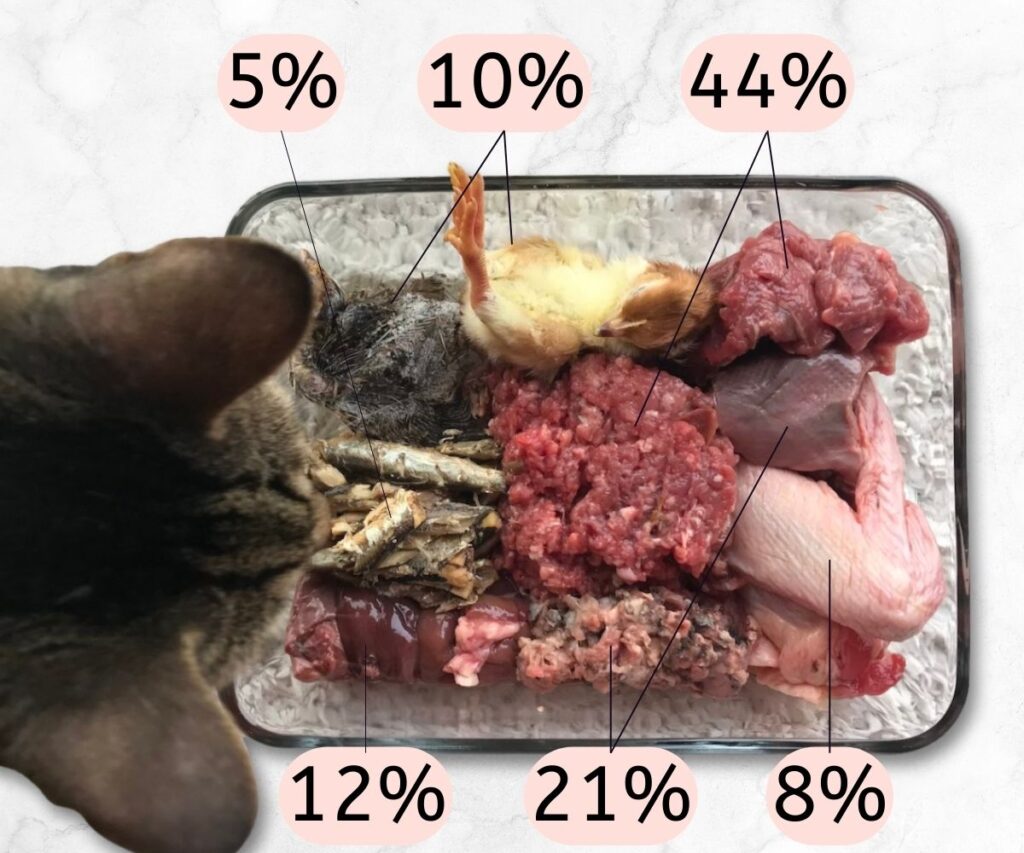
Our goal is to recreate what our cats eat in nature: whole prey. The basics are meat, bones, and organs. Plus other superfoods to fill in nutritional gaps.
Whole prey provides:
- Brain
- Eyes
- Ears
- Trachea
- Arteries
- Lung
- Colon
- Duodenum
- Pancreas
- Intestines
- Appendix
- Sex organs
- Bladder
- Thyroid
- Fur/feathers
- Teeth
- Blood
- Heart
- Liver
- Stomach
- Spleen
- Pancreas
- Gall bladder
- Kidney
- Bones
- Cartilage
- Ligaments
- Muscle tissue
- Thymus
- Skin
And that’s not even everything!
For a cat food recipe, we may use pieces like:
- Muscle tissue
- Bones
- Skin (if feeding bones with skin)
- Heart
- Gizzards (maybe)
- Liver
- Kidney (maybe)
- Spleen (maybe)
- Tripe (maybe)
So we’re going from 30+ parts and pieces that whole prey provides down to maybe 9 parts and pieces that we’re feeding in 80 10 10 diets, for example.
Yes, cats do not eat supplements in nature. But we aren’t feeding them what they eat in nature anyway.
So we have to use supplements when we don’t have access to a variety of whole foods, otherwise we may be feeding a deficient diet.
Even if we do feed whole prey, those prey are raised in breeding facilities and don’t have a natural life.
Plus, whole prey data is limited. So we still need to formulate with other whole foods and possibly some supplements.
I agree that cats do not need vegetables. But you’ll have to decide between using whole foods or supplements.
Recipe template calculator
Important: These calculators are not food formulators. The calculators do not make a complete and balanced recipe.
Instead, the calculators give you ingredient suggestions and amounts to use inside a food formulator so you have an easy starting point.
The first calculator is for a raw meaty bones recipe. And the second is for a boneless recipe.
Each calculator includes ingredient suggestions and amounts to start with based on how much you feed your cat each day.
You can enter the amount that you feed in ounces or grams. The ingredients will provide amounts in the same format that you enter because they are based on percentages and not specific to ounces or grams.
I go into detail about the formulator I recommend and the ingredients to use below the calculators.
How to formulate recipes
I highly recommend Paws of Prey Cat Meal Formulator. I bought this years ago, and I recommend it because it’s beginner-friendly.
Use the amounts in the calculators above as a starting point. Don’t worry about long decimal points. Just round up or down and adjust as necessary.
Paws of Prey guideline ratios for formulating recipes are:
- 55% muscle meat
- 25% muscular organs
- 8% raw meaty bones
- 4% liver
- 8% other secreting organs
IMPORTANT: 80 10 10 ratio diets are not complete and balanced. Instead, these ratios give you a starting point when you are formulating.
I really like these numbers because you’ll get a very close to complete recipe when you follow them.
I’ve adjusted them slightly in my calculators to include other meat superfoods that help fill in nutritional gaps.
Muscle meats
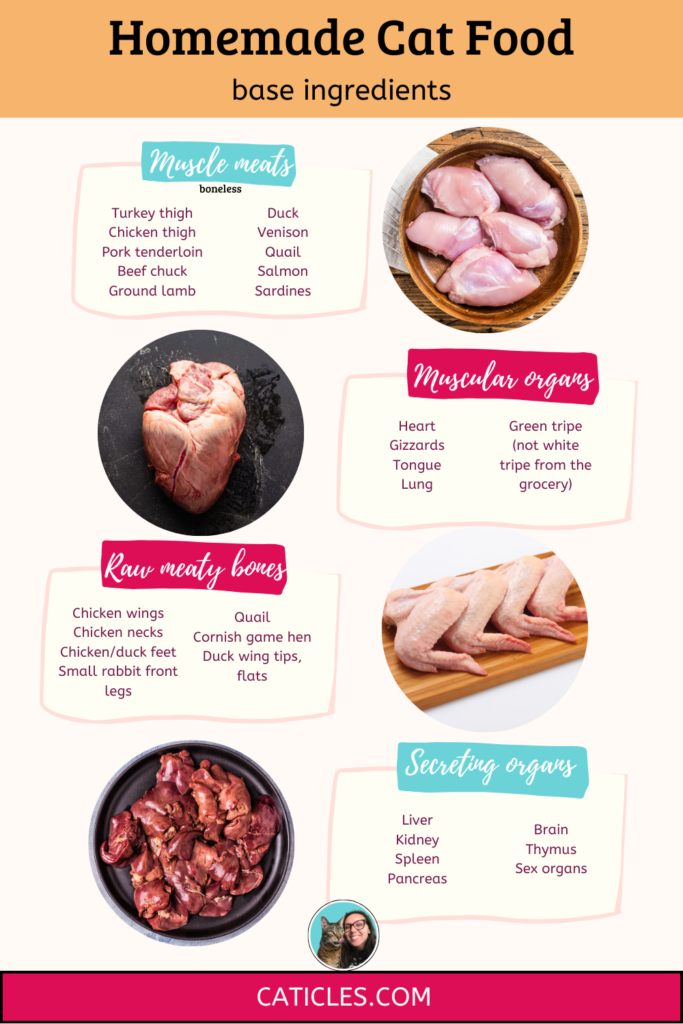
Muscle meats are standard boneless meats. These are the meats most people eat.
- Thigh
- Breast
- Chuck
- Tenderloin
- Meat from bone
- All seafood
Muscle meats fulfill protein (amino acid) requirements, provide fat (use some skin!), and help with many vitamins and minerals.
Muscular organs
Muscular organs are hard-working organs.
- Tongue
- Heart
- Gizzards
- Lung
- Green tripe (not white tripe)
We get the same nutritional benefits as muscle meats here.
Raw meaty bones
We use non-weight-bearing bones for cats.
- Chicken wings
- Chicken necks
- All quail bones
- Cornish game hen
- Small duck necks
Raw meaty bones add protein (amino acid), provide fat if you’re feeding bone with skin, and help with Ca:P ratio.
Secreting organs
These are organs that secrete.
- Liver
- Kidney
- Spleen
- Pancreas
- Brain
- Thymus
- Sex organs
Secreting organs add protein (amino acid) and provide lots of vitamins and minerals.
It’s easy to meet amino acids, fat, and most vitamin and mineral requirements when we follow the ratios above. However, there are a few nutrients that may still be low.
The most common low nutrients are manganese, iron, zinc, copper, vitamin D, B vitamins, iodine, and vitamin E.
Meat superfoods we can use:
- Manganese – green tripe & blue mussels
- Iron – oysters or spleen from beef, lamb, or pork
- Zinc – lean beef, chicken heart, oysters
- Copper – oysters or liver from veal, beef, or lamb
- Vitamin D – salmon, sardines, other oily fish
- B vitamins – pork tenderloin
- Ca:P ratio – bone meal powder
Non-meat superfoods we can use:
- Vitamin E – sunflower seeds or wheat germ oil
- B vitamins – nutritional yeast
- Manganese – ground turmeric or ginger
- Iodine – kelp or dulse
- Ca:P ratio – eggshell powder or seaweed calcium
Now, I KNOW cats are carnivores and would not eat these non-meat superfoods in nature.
But if you don’t want to use synthetic supplements… Then you will have to use these non-meat superfoods.
Formulating tips
Once you have your ingredients in, it’s all about fine-tuning the amounts used. Go back and forth between ingredient amounts and the nutritional analysis.
You can see how much of each nutrient each ingredient provides. This can help you adjust the ingredients so that you meet the minimum requirements.
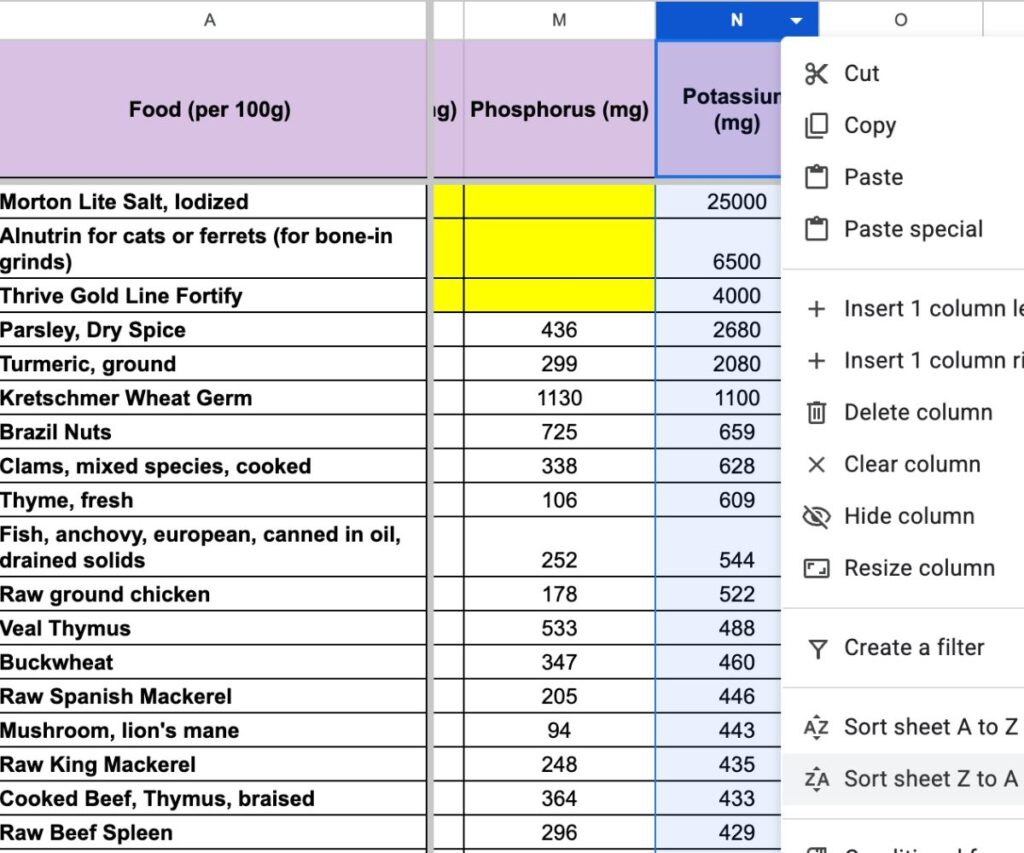
Paws of Prey formulator also has a food data tab. You can scroll to each nutrient and sort the column Z-A so that the ingredients that have the highest amount of that nutrient show up first. This can be helpful to find ingredients to make up for low nutrients.
The other feature that I love is the PMR and guaranteed analysis section. Here you will see the breakdown of what’s in the recipe vs what’s recommended.
I’ve included meat with skin/fat in my calculator because this will help you adjust the ingredients so that the fat content meets what’s recommended.
The batching tab is also very helpful. It will batch the recipe according to the number of days, weeks, or months that you’d like to make.
You can also put in the price per pound for each ingredient, and it will tell you how much you’ll spend per batch.
In the recipe example from the video above and listed below, the cost for one cat for 30 days would be just $26.34. That’s only 88 cents a day for a fresh, whole food diet!
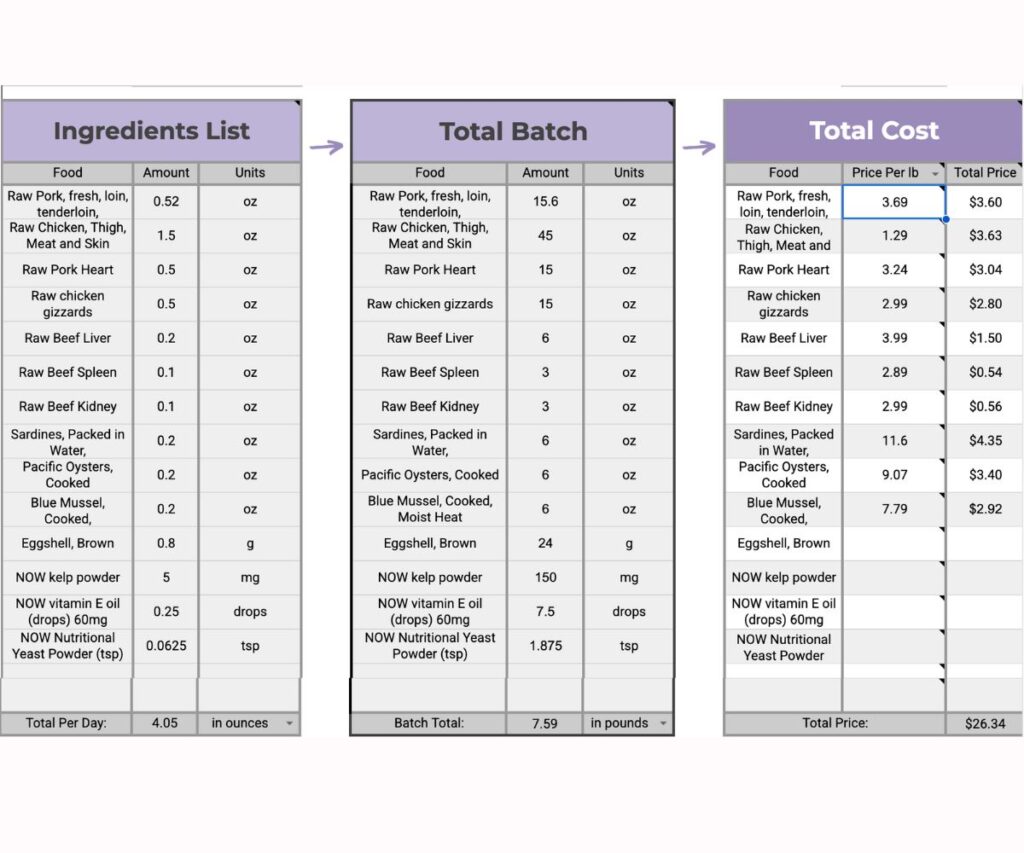
Sample cat food recipe from the video above
This recipe is formulated to AAFCO guidelines for a healthy adult cat who eats approximately 186 calories daily. The recipe makes 30 days.
Raw boneless cat food recipe:
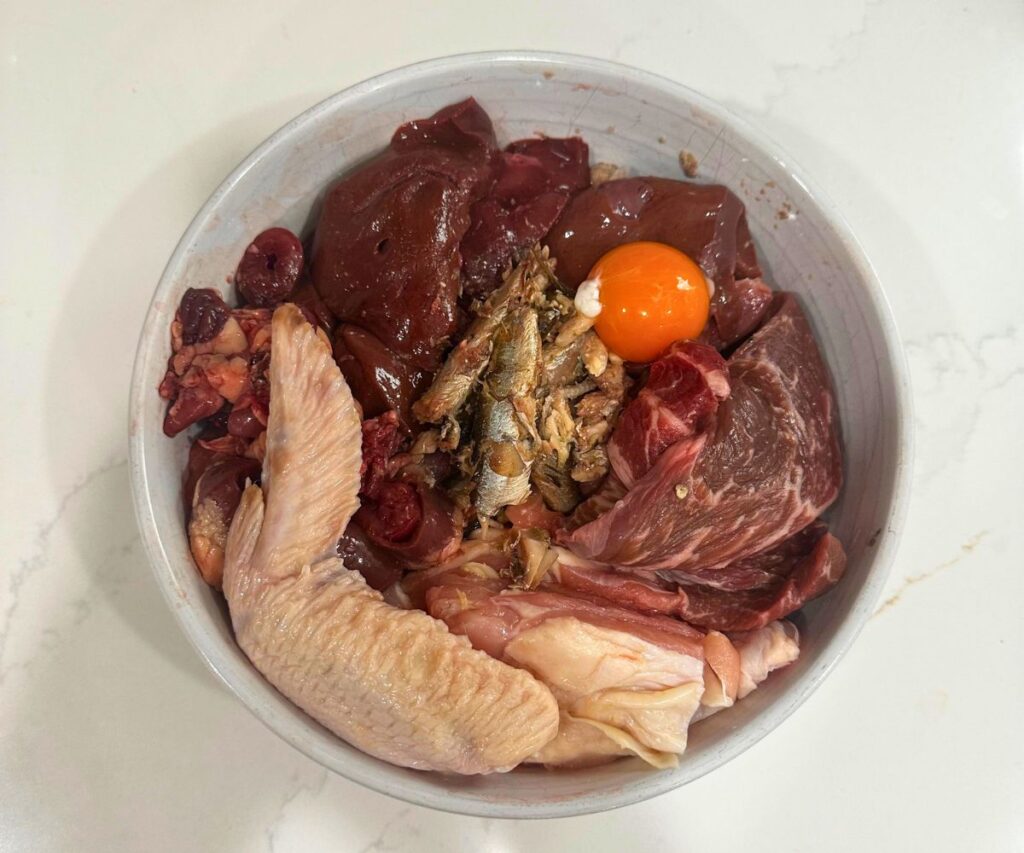
- 15.6 oz pork tenderloin
- 45 oz chicken thigh with skin (weigh this amount after removing the bones)
- 15 oz pork heart
- 15 oz chicken gizzards
- 6 oz beef liver
- 3 oz beef kidney
- 3 oz beef spleen
- 6 oz canned sardines (in water, no salt)
- 6 oz cooked oysters (check Asian markets for frozen cooked)
- 6 oz cooked blue mussels (you can get these at Lidl in the frozen seafood section)
- 24 g eggshell powder
- 150 mg NOW kelp powder (slightly less than 2 scoops)
- 7 drops NOW vitamin E oil 60 mg (90 IU)
- 2 tsp NOW nutritional yeast powder
If you need personalized support and want to get your recipe reviewed, I highly recommend Paws of Prey Club. She provides recipes every month, answers your questions, and does recipe review calls once a month.
Need help making your cat’s raw food? Check out my full how to make DIY raw cat food guide.
